
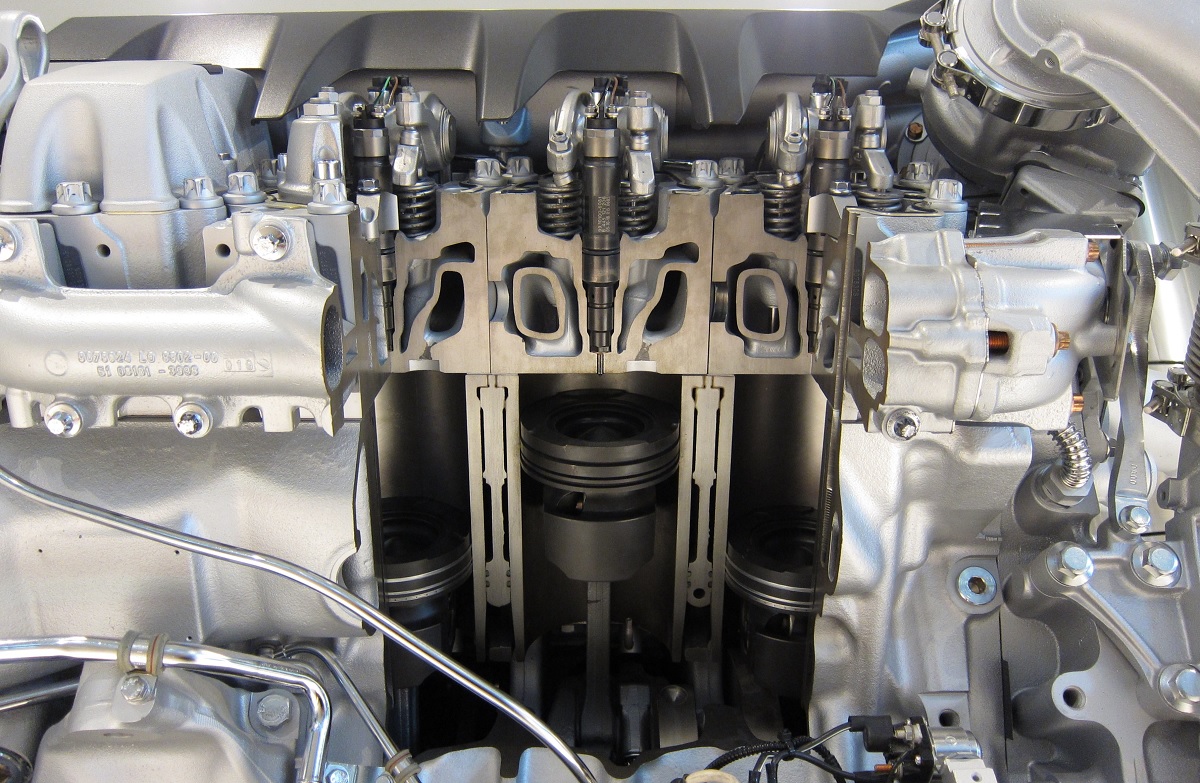

While pressure is often emphasized in the marketing of diesel fuel systems, it is important to note that pressure alone is not sufficient. The performance of an engine greatly depends on the injector’s ability to maintain a steady pressure, control the spray pattern accurately, and consistently repeat this process thousands of times per minute without deviating from the required specifications. This level of precision engineering is what truly makes a difference in the performance of an engine.
Why pressure alone doesn’t solve combustion
Common-rail direct injection systems on modern diesels run a shared rail that feeds every injector at a constant, extremely high pressure. Depending on the application, that’s anywhere from 2,000 to 2,700 bar, or roughly 30,000 to 39,000 psi. Injection pressures in commercial vehicles have roughly doubled since the technology entered production in 1997, climbing from the original 1,350-bar systems to today’s 2,700-bar systems.
Higher pressure by itself doesn’t mean better combustion. It means finer atomization is possible – but only if the injector geometry that shapes the spray is held to a tolerance tight enough to take advantage of it. Push high-pressure fuel through a nozzle with an imperfect seat or an uneven orifice, and you don’t get a finer mist. You get an inconsistent one. Some of the fuel atomizes well, some of it doesn’t, and the parts that don’t burn clean show up later as soot, smoke, or wasted fuel.
The tolerances involved are almost impossible to picture
Injector needles, nozzle seats, and pintles are machined to single-digit micron tolerances. For scale, a human hair is roughly 70 microns thick. A few microns of wear on a seating surface or a rougher-than-spec surface finish on a needle is enough to distort the spray angle and alter how the fuel shatters as it exits the nozzle.
This is why injector wear doesn’t announce itself with a dramatic failure most of the time. It shows up gradually – slightly rougher idle, a bit more smoke on acceleration, a small drop in fuel economy – because the geometry has drifted just enough to change how the fuel burns, not enough to stop the engine from running. By the time a driver notices something’s off, the injector has often been degrading for a long stretch of miles.
Multi-injection strategies raise the bar further
Modern diesels don’t fire an injector once per cycle. They fire it multiple times – a pilot injection to soften the initial combustion event, a main injection to deliver the bulk of the fuel, and sometimes a post injection to manage exhaust temperature or assist aftertreatment. Each of these events might last only a few hundred microseconds.
That means the needle has to lift and reseat cleanly, multiple times, within a single engine cycle, while holding cracking pressure consistently between each pulse. Whether the injector uses a solenoid or a piezoelectric actuator, the switching speed and consistency of that actuator determines how tightly the engine can control timing and duration. A worn pintle or a sluggish actuator doesn’t just affect one injection event – it throws off the entire multi-pulse strategy the engine control unit was calibrated around.
How the nozzle gets made matters as much as the design
Two injectors can have the exact same spec sheet and behave totally differently, because the way the nozzle orifice was made isn’t the same in the manufacturing plant. Laser drilling and electron-beam drilling are the most common ways of getting through the metallurgical voodoo needed to pierce those microscopic holes the fuel flows through on its way to the cylinder. When that’s done correctly, and the orifice is subsequently subjected to a hydro-grinding that both rounds and deburrs the hole, you wind up with a symmetrical orifice having a nice, predictable flow coeff.
Skip or cheap out on that, and you get burrs and sharp edges where the hole comes through. Fuel passing through a rough hole does not atomize into a nice, even spray pattern. It tends to spray unevenly. It tends to run in too deep or not deep enough. It tends to hit the cylinder wall and pool rather than mixing evenly with the air charge. And, in addition to all that, the rough edges become a convenient site for carbon deposits, which means that the spray pattern gets worse the longer the injector runs. This is probably one of the most vivid areas where “like the original part” and “works like the original part” diverge.
Flow matching is the part most people skip
While the total flow rate is considered important for injector updates, it can be argued that flow matching is more important across a complete set. It is essential that each cylinder receives the same dose of fuel at the same time, with minimal variance. If the injectors are not matched within a set, some cylinders will receive slightly more fuel while others will receive slightly less.
The effects of this are easy to notice. Injectors that are not matched will lead to instability when idling, uneven distribution of power, white smoke emission and in the worst cases, the imbalance in fuel between cylinders is sufficient to create conditions like rod knock. It’s possible for injectors that individually flow great but were never assembled as a finely-tuned set to leave the engine running worse than one with slightly less flow but much tighter matching.
Where rebuilt injectors quietly cut corners
Rebuilt and remanufactured injectors are popular in the diesel world since a complete OEM replacement set is costly. The issue is not the idea – it is that a “rebuilt” term includes a broad scope of actual work. A legitimate rebuild replaces the wear components, re-verifies pop pressure on a bench tester, checks the leak-down rate, and for solenoid or piezo units, tests the electronic response under load.
A shortcut rebuild swaps a couple of obvious parts, reassembles the unit, and forgoes the verification steps completely. It may work fine for a while. Also, it is far more likely to fail early, since the components that really determine spray quality – the nozzle, the seat, the needle fit – were never examined against the micron tolerances they need to maintain. This is the difference between a part that is defined as “remanufactured like OEM” and one that has been tested against OEM specs.
This is precisely where the owners looking for fuel injectors for 5.9 Cummins need to slow down and ask what is actually being measured. A builder who publishes cracking pressure figures, leak-down rates, and flow-matching data for a set is telling you something concrete. A listing that simply says “remanufactured” or “tested” without numbers is not offering anything that you can verify. Precision engineering only means something if it is documented.
Soot, DPFs, and the cost of sloppy atomization
Poor atomization doesn’t stay contained in the combustion chamber. Fuel that doesn’t burn completely turns into soot, and that soot has to go somewhere. On engines with diesel particulate filters and EGR systems, excess soot from a dribbling or misaligned injector is one of the most common causes of premature DPF clogging and failed regeneration cycles.
An injector that leaks slightly past its seat, rather than snapping shut cleanly, is called a dribbler in the trade. Instead of a sharp, well-defined spray event, it leaks a small amount of fuel into the cylinder outside the intended injection window. That fuel burns poorly, if at all, and the byproduct is exactly the kind of particulate that overloads a DPF faster than it was designed to handle. Chasing a DPF problem without checking injector spray quality first is a common and expensive mistake.
Why bigger injectors on a modified 5.9 Cummins can backfire
People who have modified a 5.9 Cummins often seek out higher-flowing injectors because they think that more fuel equals more horsepower. That statement is true, assuming the added flow meets or exceeds the atomization and timing characteristics of the stock injector. An oversize injector manufactured without the precise nozzle geometry and needle control of the stock injector will not provide a cleaner, higher-volume combustion charge – it will simply dump more raw fuel less precisely.
In the real world, this translates into more smoke and higher EGTs, two indications of poor performance rather than a good, clean, efficient power increase. A larger properly engineered injector simply flows more while maintaining the spray pattern and needle response. A poorly designed larger injector flows more while exaggerating the problems, exactly the opposite of an efficient power increase.
What to actually check before buying
Ultra-low-sulfur diesel has lower natural lubricity than older diesel fuels, which puts more wear stress on tightly fitted injector components over time. Combine that with thermal cycling and cavitation inside the nozzle – both of which erode fine edges and slowly change orifice geometry – and it’s clear injectors are wear items, not permanent fixtures. That makes verification at the point of purchase, not just at installation, worth taking seriously.
It’s not the advertisement that determines injector quality. The question is whether the builder can produce a pop tester reading verifying cracking pressure, demonstrate a leak-down rate within spec, and – ideally – supply spray pattern footage indicating a symmetrical, well-atomized cone rather than a lopsided stream. Anyone can claim precision in manufacturing. Show me the bench data.
Diesels have always been about details rather than just big power numbers, and injectors are the first place those show up in practice. Chasing an extreme pressure rating misses the part of the iceberg that’s most important.

Comments are closed.